⚡">
Field Test · Footwear Engineering

The Best HYROX Shoes (2026): Friction, Stability & 8km Running Tested

HYROX is an engineering paradox: driving a 152kg sled requires high turf friction and zero midsole squish, yet surviving 8 separate 1km running splits on concrete demands responsive foam rebound. Here is an objective, station-by-station evaluation of the leading hybrid contenders.

Updated: October 2026 • 8 × 1km Format Analysis • Turf Friction & Station Audits

The Race Format: 8 × 1km Running + 8 Workout Stations

A standard HYROX race alternates continuously: 1km of running on hard arena concrete followed by 1 workout station, repeated 8 times for a total of 8km of running and 8 functional workouts.

The shoe you choose determines your compromises: pure running shoes gain seconds on the laps but risk ankle deflection on wall balls or backward slippage on the sled push. Conversely, pure gym lifters offer rock-solid station stability but beat up your calves and shins across 8km of concrete.

Segment Biomechanical Demand Footwear Weak Point Ideal Shoe Attribute
Run 1 (1.0 km) Fresh aerobic pacing on hard indoor arena concrete Flat gym lifters shock lower back and shins Responsive foam cushion
Station 1: SkiErg (1,000m) Hinge power, triceps & downward hip drive High squishy stacks sap downward force transfer Stable, non-compressive platform
Run 2 (1.0 km) Establishing cadence; lats and triceps working Rigid cross-trainers (>340g) add swing-weight drag Lightweight build (<280g)
Station 2: Sled Push (50m @ up to 152kg) Horizontal shear drive at a 45° forward lean Smooth road outsoles slip backward on synthetic carpet High-tack sticky rubber or ribbed micro-lugs
Run 3 (1.0 km) Running through extreme quad burn right off the sled Dead foam gives zero turnover assistance Forefoot rocker or responsive rebound
Station 3: Sled Pull (50m @ up to 103kg) Static backward heel-planting traction under load Rounded heel rockers slip backward under rope load Flat, squared-off heel contact patch
Run 4 (1.0 km) Mid-race transition; hamstrings under tension Zero-drop shoes over-stress tight calves Moderate drop (6–10mm)
Station 4: Burpee Broad Jumps (80m) Explosive horizontal leaps & chest-to-deck landings Heavy lifters feel like lead weights on takeoff Forefoot flex grooves & reinforced toe wrap
Run 5 (1.0 km) Aerobic recovery split after explosive jumps Dense rubber soles transmit harsh ground impact Cushioned supercritical or EVA blend
Station 5: Rowing (1,000m) Cadenced leg extension against foot stretcher Overly flared heel outsoles wedge inside foot cups Slim, beveled heel geometry
Run 6 (1.0 km) Deep fatigue re-entry; postural stability working Narrow, tall super-shoes wobble as ankles fatigue Broad, stable base
Station 6: Farmers Carry (200m @ 2×24kg) Postural stability & high ground reaction force per stride Soft running foams squish medially under combined weight Firm lateral sidewall support
Run 7 (1.0 km) Crucial pacing split preceding heavy leg failure station Lack of arch containment increases foot fatigue Torsional midfoot stability
Station 7: Sandbag Lunges (100m @ 20kg) Unilateral knee flexion & deep toe articulation Stiff full-length carbon plates fight natural toe flex Articulated forefoot flex or spoon plate
Run 8 (1.0 km) Final 1,000m sprint on heavy legs Clunky gym shoes prevent turnover acceleration Energy return propulsion
Station 8: Wall Balls (100 reps) 100 deep squats to depth + overhead throws under peak fatigue Compressible running heels cause ankle wobble and missed depth Dense heel anchor (no squish)

Matching Footwear to Your Weak Points

No shoe is objectively best at everything. The ideal choice depends on where you bleed the most time:

Profile A: The Strong Runner Bleeding Time on Stations

Prioritize: Heel Rigidity & Turf Friction

If your 5K is sub-21:00 but you lose minutes slipping on the sled push or shaking during wall balls, avoid high-stack road racers. A structured cross-trainer like the Reebok Nano X4 or Nike Metcon protects your station splits with zero heel compression, while your natural aerobic engine carries the 1km laps.

Profile B: The Functional Lifter Dying on the 8km Runs

Prioritize: Foam Rebound & Rocker Geometry

If you fly through the sleds and lunges but your pace drops past 5:30/km on the running laps due to shin splints and leg fatigue, avoid traditional flat gym shoes. Choose a runnable hybrid like the Puma Deviate Nitro 3 HYROX or Adidas Dropset Elite to save your joints over 8 accumulated kilometres of concrete.

The 4 Contenders: Field Tested

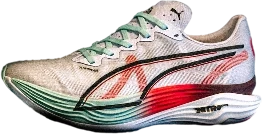
Puma Deviate Nitro 3 HYROX
Plated Hybrid Racer 10mm Drop Carbon Composite Plate

Puma Deviate Nitro 3 HYROX

Stack: 38mm/28mm • ~265g • PUMAGRIP Compound

The Verdict: Exceptional runnable foam and unmatched friction on synthetic turf thanks to PUMAGRIP. The carbon composite plate provides propulsion on the runs, though the high 38mm stack demands careful balance on deep lunges and wall ball depth.

Check Puma HYROX Range →
Reebok Nano X4
Station Anchor 7mm Drop TPU Heel Cradle

Reebok Nano X4

Stack: 19mm/12mm • ~340g • Floatride Energy

The Verdict: Built for athletes who want rock-solid grounding. The rigid TPU chassis eliminates ankle roll under heavy loads (farmers carry, wall balls), but the 340g weight and firmer midsole demand more effort over the 8km running segments.

Check Reebok Nano Range →
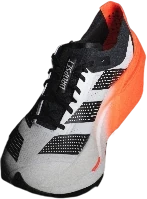
Adidas Adizero Dropset Elite
Superfoam Hybrid 6mm Drop Lightstrike Pro

Adidas Dropset Elite

Stack: 26mm/20mm • ~270g • Traxion Outsole

The Verdict: Combines race-tested Lightstrike Pro cushioning with a lower, more stable 26mm profile than typical marathon racers. Gives fast turnover on the run splits while maintaining decent lateral containment on stations.

Check Adidas Dropset Range →
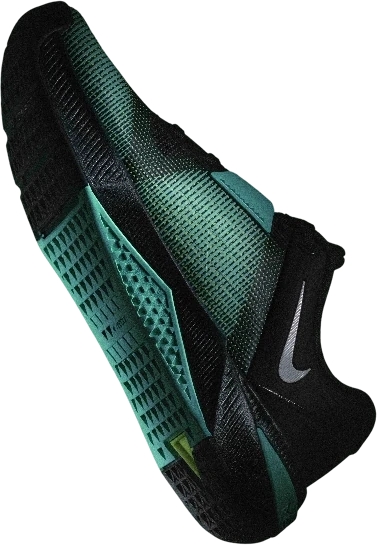
Nike Metcon Series
Lateral Rigidity Specialist 4mm Drop Hyperlift Plate

Nike Metcon Series

Stack: 15mm/11mm • ~350g • Hyperlift Heel

The Verdict: The undisputed king of zero heel compression for heavy squats, sled pulls, and wall balls. The trade-off is running stiffness: the low 4mm drop and firm sole make 8km of concrete feel punishing for athletes without resilient calves.

Check Nike Metcon Range →

Head-to-Head Technical Matrix

Model Drop Weight Turf Grip Running Economy Station Stability Ideal Athlete
Puma Deviate Nitro 3 HYROX 10mm ~265g 9.5 / 10 9.5 / 10 7.0 / 10 Balanced competitors wanting run split speed
Reebok Nano X4 7mm ~340g 8.5 / 10 6.5 / 10 9.5 / 10 Strong lifters prioritizing wall ball & sled grounding
Adidas Dropset Elite 6mm ~270g 8.5 / 10 8.5 / 10 8.0 / 10 Moderate stack seekers wanting Lightstrike foam
Nike Metcon Series 4mm ~350g 8.0 / 10 5.5 / 10 10 / 10 CrossFit crossovers wanting maximum base rigidity